|
|
Our
commercial fishing operation is very different than what most people
think of when the topic of a fishing business comes up. Although
we do catch fish in the summer with gill nets set in the river and use
a boat to work the nets, our main fishing operation takes place in
the winter with
gill nets set under the ice on the frozen river.
How is this possible, you ask?
|
|
| Let me explain. |
|
We
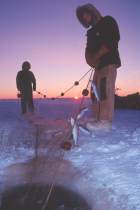
fish during early winter months by stringing gill nets below the
surface ice and thus catching fish swimming in the water
below the ice. We catch mainly Arctic Cisco, Least Cisco,
and Humpback Whitefish as they feed and move about in
the delta face for several months each fall.
We start by
knowing ahead of time where the right depth of water is located in
order to set the nets in the best location for the
fish runs. The ice needs to be frozen several inches deep
in order to support our weight while walking around on
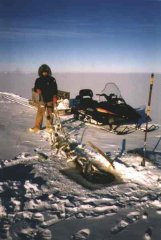
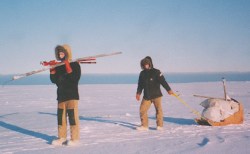
the ice. Nets and equipment are hauled out to the setting
site on a small hand sled to begin with, later a snowmachine and sled
is used.
|
|
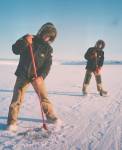
Holes about 1 ½ foot diameter are cut in the ice with a hand
held ice chopper (duke) in a straight line about 15 feet apart. Enough
holes must be opened to cover the length of the net to be set. Next we
drop a weighted line that is connected to a long rope down the first
hole. Using a long pole with a hooked end, we reach in under the ice
from the second hole to catch the line hanging down from the first hole
and pull it in under the ice back
to the second hole. We continue doing this from hole to hole until we
have the long rope strung under the ice for 150 feet to match the
length of the net we intend to set. Once the rope extends under the ice
for the entire length necessary, it is attached to the net at the first
hole and
the net is pulled under the ice, the rope thus coming up
on top again from the last hole. Often several nets are
set in a line to make use of the previous net's last hole.
|
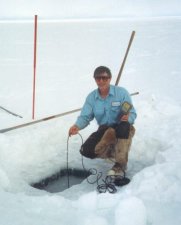 |
Jim at net hole checking water
depth and salinity.
|
|
Short ropes
attached to the ends of the net are tied to strong sticks we freeze
into the ice on the edges of the first and last hole.
These sticks lean out at an angle over the holes to hold
the ropes in the center of the hole. After a net is set,
the holes between the first and last hole are allowed
to freeze over and are no longer needed. The net is now
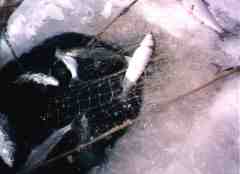
stretched out in the water under the ice and small cork
floats along the top of the net keep it floating upright.
A weighted leadline keeps the lower end of the net stretched
down near the bottom of the river so the net doesn't freeze into the
underside of the surface ice. Having at least two people to handle the
nets and the pull rope is best, as one person can guide the net in or
out of the hole as the second person pulls on the net or rope.
|
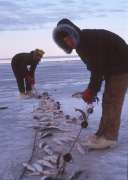
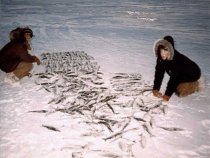
The
several different species of whitefish that we catch are sorted as
we pull them out of the net (by tossing them to opposite sides of the
net) and then they get counted and left to freeze on the ice as further
nets are picked.
|
|
pick
fish
count fish
|
Nets are
pulled up and picked of fish only one at a time, and only enough net is
pulled above water that can be cleaned of fish
before the fish begin to stiffen with the cold. Each net
is pulled back under the ice after fish have been removed.
|
|
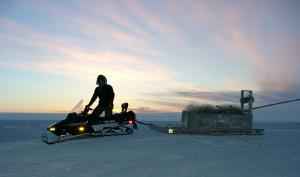
Jim brings nets and
equipment home .
|
|
After all
the
nets (some years only a few, some years dozens) are cleaned of fish,
the frozen fish are put in a large box on a
snowmachine sled and hauled up to the storage building
for later sacking and marketing in 100# bags. They are
sacked as whole fresh-frozen fish, and are sold throughout
Alaska.
|
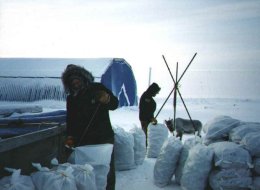
sacking and weighing
fish
What a BIG job!
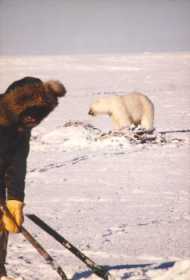
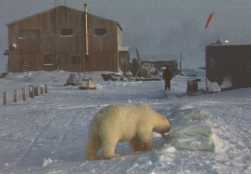
Fishing season
sometimes means special visitors:
|
|
| Derek at fishing hole with polar bear eating
fish from near-by fish pile. |
A visiting
polar bear sniffs sacks of frozen fish near Colville Lodge. |
|