|
Out of the Ordinary
Colville River Delta Offers Appealing Lifestyle
by Teena Helmericks
Have you ever wished you could live somewhere special or do something
out of the ordinary? Well, my family and I do, and not because we deliberately
set out to do so, but because we grew up doing so, and thought nothing of
it.
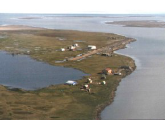
We live on a three-generation homesite on the northern coast of
Alaska about 60 miles west of Prudhoe Bay. Colville Village, as we call it,
sits on Anachlik Island on the outer edge of the Colville River Delta. My
husband, Jim, is the oldest of three sons raised here in the Arctic. His parents,
Bud and Martha Helmericks, settled in the Colville River Delta in the early
1950's when Jim was a small boy. They built up our present homesite beginning
with nothing but a wall tent surrounded by snow blocks for their first home.
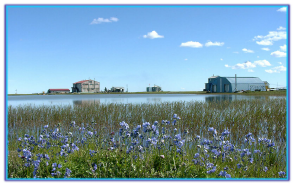
Now there are modern two-story homes, a hanger for our planes, power and
storage buildings, greenhouses, ice cellars, guest quarters and many other
improvements to make a self-sufficient community.
Many Endeavors
The Helmericks Homesite became the family's
base of operation for numerous endeavors. A commercial fishing operation was
started to supply Barrow and other villages with fresh whitefish from the
Colville River. A flourishing big-game guiding operation developed, and later
an air taxi came into being because of the demand for the expert flying skills
which both Bud and Jim possess. The Helmericks became involved in the explosion
of the oil industry on the North Slope, providing consultation and advise
about environmental protective measures and clean-up operations, and in guiding
or instructing the newcomers on the best ways to operate and survive under
arctic conditions. We have kept daily records over all the years of weather
conditions, game seen, and important aspects of arctic life. These records
have become a valuable source of information on our area of the arctic.
I lived in Barrow during the 1950's when my father, Rev. William
Wartes, was the Presbyterian missionary-pilot for the whole North Slope.
My family and the Helmericks family became close friends during those years
and Jim's and my father often flew their planes together over the vast stretches
of the arctic. My early years in northern Alaska gave me a fortunate background
and profound love for the Arctic so that when I married Jim and returned to
the Helmericks homesite in 1970, I felt like I was returning home.
It has been natural that Jim and I should continue in the work and
lifestyle that we grew up with. We still carry on the commercial fishery,
operate the air taxi, and guide sportsmen and other outdoor enthusiasts. We
provide support services for many types of operations including the oil industry,
scientists from around the world, and various government agencies.
Home Taught Kids
And now we are raising our own four sons
in the tradition of these Arctic ways. Being born and raised in the Arctic,
they know no other life, and even more so than their parents, they take their
extraordinary life for granted. Both winter and summer alike, the outdoors
becomes a fascinating playground for them. And like most children, summer
is their favorite time of year, for school is out and they are free to roam
at will. Yes, even here on the edge of the Arctic Ocean, school can't be shirked.
Mother becomes schoolteacher for half a day, six days a week. I teach the
boys their lessons with a state provided correspondence program. Summer vacation
becomes a blessed relief from the rigors of school for me as well as the
children. Then there is time for many extra projects (work and play) that
usually can't be fitted in during busy school days.
Come September though, the books open again and off we go for another
school year. Our son Derek, who is eleven, will be in the sixth grade this
fall, eight year old Jay will be in fourth grade, five year old Isaac will
be a first grader, and two year old Aaron is in perpetual mischief. Teaching
the children at home by correspondence is not easy but has definite benefits.
We are able to remain year-round at our long established home, keep the family
together, and be in control of the quality of education and outside influences
affecting our children.
Although correspondence schooling is nothing new for many Alaskan
families living in the "bush," it is certainly unique for the North Slope.
I believe our family and others who have lived here with us are the only residents
on the North Slope who permanently reside outside any established town. Thus
correspondence schooling is the only way to provide our children's education,
and still remain together as a family.
Not So Remote
Our home used to be considered isolated back
when Barrow was the closest community about 165 miles to the west of us.
But nowadays we have many neighbors. The village of Nuiqsut was established
22 miles upriver from us, and the many oil camps and rigs of the Kuparuk Oil
Field are 10-18 miles east of us. We have often had seismic camps working
all around us during the winter months. The twinkle of lights can be seen
all around during the dark days and civilization continues to creep closer
each year. It would hardly seem right to refer to our place as remote any
longer.
Of course we never have considered our life one of isolation or
loneliness anyway, even when neighbors were nonexistent, for we have always
had many visitors throughout the years due to our location and means of livelihood.
My guest book, started years ago, has hundreds of names and address of people
from all over the world - people who have stayed days or weeks with us, or
people who have simply dropped in for coffee and a short visit. We have also
had other families or single individuals living and working here with us at
Colville Village over the years. All in all, loneliness has never been a
problem. (Add four rambunctious boys and it is a "circus" half the time.)
Hard Work
Our life is one of freedom and independence,
but just as in any pioneer lifestyle, there is no end to the hard work and
challenges to be faced. Our lives are much easier than our parent's lives
were in the early days here on the Colville, yet there is still much to be
done the hard way, especially during the harsh winter months. We heat our
spacious home with wood and this means many hours a week of gathering and
cutting wood for the stove. Much of the wood we burn is drift willow that
Jim digs out from under snow along the river banks and then hauls home by
snowmachine and sled. It takes several large loads of wood each week.
Water-haul chores during the months when outdoor water lines remain
frozen are always time and energy consuming. The water must be hauled from
our nearby freshwater lake in large containers by snowmachine and sled, and
then carried into the house with 5-gallon buckets and poured into our indoor
holding tank. From here, a battery-operated water pump keeps the indoor water
lines pressurized. I have drains that work all year, but the "honey bucket"
must be dumped by hand in our local landfill. In the summer the water chores
are lessened thanks to a windmill. It pumps water into a large holding tank
atop one of the buildings and from there we have gravity flow water pressure
to all the buildings.
Precious Electricity
Electricity is only a temporary convenience.
We have our own generators for our electrical needs, but due to the high fuel
costs, this is a convenience we allow ourselves only periodically. It is
used for such things as laundry day or charging the many batteries that run
our radios, phone system, and other electrical equipment. (For instance, the
children have a battery operated TV and computer for educational programs.)
Besides, you can't imagine the peacefulness of true silence away from the
racket of motors, generators, and other noisy equipment. We enjoy this true
quietness most of the time.
Just the mechanics of everyday life here can be a full-time job,
yet there must be time for enjoying the land we live in also. Camping
adventures or river excursions are favorite outings. We are all avid birders,
so watching, studying, or just enjoying birds when they return to the arctic
is another favorite pastime. (Then the arctic quietness becomes an arctic
song.) Jim especially is an expert on all birds of the Arctic, for he has
studied them for over 30 years. The children too have a rare knowledge
of both birds and wildlife of the area, for they have lived and breathed
them since babyhood.
Birds & Animals
This fascination for Arctic wildlife has led us into developing an interesting
and educational museum with many beautiful birds and animals mounted for display.
We also have Arctic relics and artifacts and an elaborate collection of prehistoric
animal bones, mammoth tusks, and fossil shells. These are always of special
interest to any guests we have.
One of the most unusual aspects of our life in the Arctic has been
the small farm animals we have raised over the past 12 years. We have built
a well insulated barn that has housed dairy goats, rabbits, laying hens, and
various domestic ducks and geese. All of our birds and animals have wintered
well in the barn and thrive outdoors on the Arctic prairie all summer. Fresh
milk and eggs are an appreciated commodity. We can assuredly boast of
having the furthest north small farm animals in the United States!
Yes, we do realize that we live somewhere special and are doing
something out of the ordinary. The whole Helmericks family has a lot to be
proud of considering what has been accomplished over the years. There is a
lot to show for the many years of hard work and dedication to this land and
home of ours.
*********************************************************
|